
A romance travel campaign needs a source market the business can serve well. “Local” and “global” are too broad to decide a budget: a nearby drive market, a domestic flight market and an overseas advisor network each create different information, distribution and servicing needs.
For destination marketers, the useful decision is which audience to test next, with which offer, through which channel. A larger potential audience is not evidence of affordable acquisition or sufficient operating capacity.
Key Takeaways
- Separate local supplier relationships from local traveler targeting.
- Define markets by practical travel and service needs.
- Check language, transport and response capacity before expanding reach.
- Set a test budget, success criteria and review point in advance.
- Compare qualified inquiries and confirmed outcomes, not reach alone.
Define what local and global mean for this campaign
“Local” can mean guests who live nearby, businesses supplying the experience, or marketing adapted to a particular region. These are different jobs. A property can work entirely with local vendors while selling to overseas couples.
“Global” should not mean launching an undifferentiated campaign everywhere. Define specific source markets by geography, language, route access, occasion and other relevant needs. Avoid assuming that domestic guests seek inexpensive trips or that international guests always want luxury.
Use existing inquiries to identify audiences you can describe accurately. If the records are sparse, label the proposed audience as a hypothesis and begin with a limited test.
Compare markets against your ability to serve them
A nearby audience may need useful driving directions and a short-stay offer. An overseas audience may need transfer information, clearer arrival planning and a response process that spans time zones. The exact needs depend on the offer, not a universal domestic-versus-international profile.
The following is an illustrative comparison framework:
| Decision | Nearby or regional audience | A specific international audience |
|---|---|---|
| Travel access | Check driving routes and relevant domestic connections. | Check actual routes, connections and transfer information. |
| Content | Explain the occasion and why the trip is worth making. | Add source-market language and practical planning information where needed. |
| Partners | Evaluate regional planners, advisors and relevant businesses. | Evaluate advisors or distributors serving that source market. |
| Service | Confirm package and short-stay operating capacity. | Confirm language support, response coverage and supplier coordination. |
| Measurement | Identify source geography and qualified inquiries. | Also distinguish language, partner and route-related questions. |
Do not market a connection or service merely because it appears feasible. Have the relevant team verify what is actually available and keep claims current.
Build a message around a real planning task
Select the occasion and decision the campaign supports: comparing ceremony venues, finding a honeymoon package or choosing an anniversary stay. Explain the experience, inclusions, exclusions and next step clearly.
Keep the core offer consistent while adapting information to the audience. Translation alone may not resolve uncertainty about meal plans, room occupancy, local transport or the roles of an advisor and hotel. Ask someone familiar with the source market to review wording and imagery for accuracy and relevance.
For a destination, agree which details partners maintain and who handles inquiries. A campaign should not imply that a directory or contact form confirms room availability or makes a booking.
Start with a test the team can support
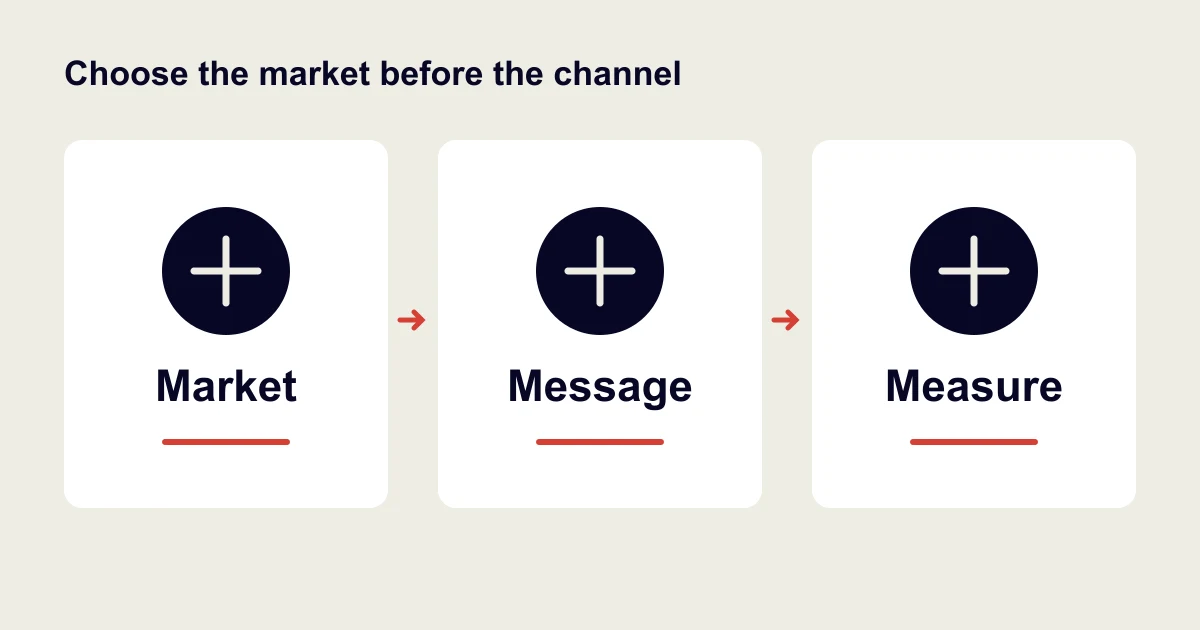
Choose one audience, a defined offer and a small set of channels. That might be a regional planner partnership, a source-market landing page or a paid campaign pointing to a specific inquiry process. These are test options, not guaranteed routes to demand.
Set a budget ceiling and include production, translation, partner work, media and staff response time. A campaign with little paid spend can still require substantial servicing effort.
Write the conditions for continuing or stopping before launch:
- What qualifies an inquiry for this offer?
- Which travel dates and capacity are available?
- Who responds, and in which language?
- Which results are observable during the test?
- What issue would require a pause or correction?
- When will the team review results?
Choose the test duration using the relevant inquiry-to-decision history. Where no history exists, record that limitation and allow for unresolved decisions rather than declaring early inquiries unsuccessful.
Compare quality and contribution across markets
Track the channel and campaign alongside source market, occasion, requested travel dates and outcome. Keep website interactions, inquiries, proposals and confirmed reservations as separate stages.
A low cost per inquiry may conceal unsuitable dates, budgets or needs. Review the proportion that meets your definition of qualified and the reasons prospects decline. Unknown outcomes should remain unknown.
Assess the business value using a consistent time period and its own economics. Hotel room revenue, a destination’s local visitor spending and an advisor’s retained commission are different measures. Do not compare them as interchangeable returns on marketing spend. For destination-level reporting, use a bounded wedding visitor-spending model.
Small samples also need restraint. A few high-value inquiries may justify further investigation without proving that one country or channel will outperform another over a full season.
A completed source-market evaluation
The following is a fictional completed decision record, not a campaign result or a claim about either market’s spending.
Imagine a hotel comparing a regional drive market with a French-speaking overseas market for the same weekday anniversary offer. Its fictional readiness check records:
| Decision field | Regional drive market | Overseas market |
|---|---|---|
| Offer information | Current English page explains the stay and driving directions. | French-language offer and transfer information are not ready. |
| Response ownership | An assigned staff member can handle the proposed inquiry window. | No French-speaking response arrangement has been confirmed. |
| Distribution test | A regional planner has agreed to review the offer. | No relevant source-market partner has been selected. |
| Recorded decision | Prepare the defined regional test. | Hold promotion until language, transfer and response gaps are resolved. |
The output is a readiness decision, not a forecast that nearby guests will be more profitable. The team documents the overseas gaps and a review owner rather than labeling the market unsuitable forever.
Expand only when the next step is clear
A successful test should tell the team what to do next: repeat the offer, improve the response process, revise content or investigate an operational barrier. It should also show whether serving more inquiries is realistic.
If prospects repeatedly ask about a missing transfer option, solve that question before increasing reach. If a translated page attracts visits but few suitable inquiries, check the message and offer before adding another language.
Use the evidence to choose the next source market or deepen the current one. A focused regional campaign and a carefully supported international campaign can both be sensible; each needs a defined customer task and a reviewable result.
Editorial note: Published by LOVU Travel. Contact us with questions or corrections. Examples identified as hypothetical are planning illustrations, not measured customer results.