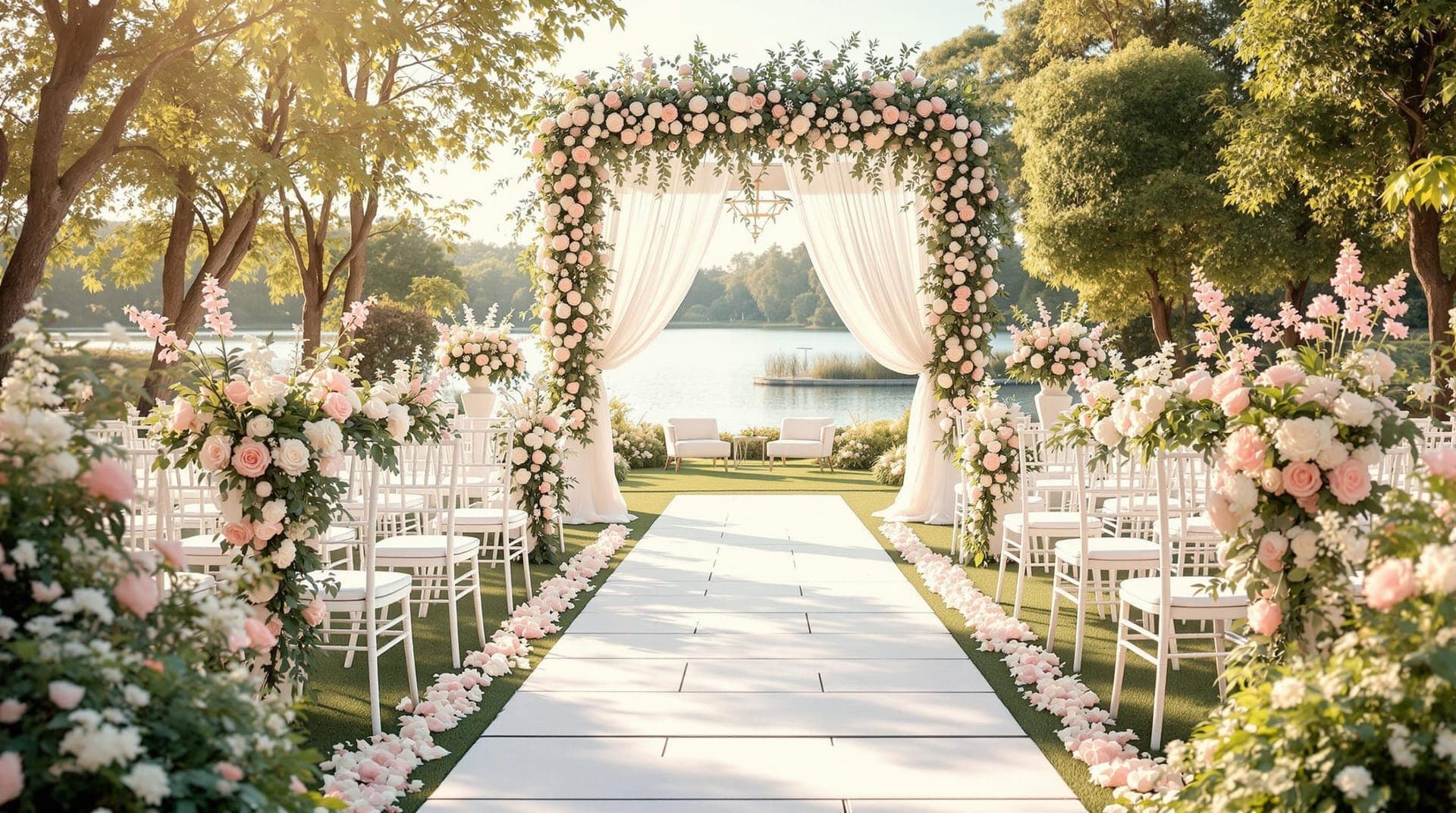
Want more bookings for your wedding venue? Avoid these 7 common marketing mistakes:
- Outdated Online Presence: Old websites, broken links, and missing details drive clients away. Update your site with virtual tours, mobile-friendly design, and fresh content. Stay active on social media.
- Using Stock Photos: Generic images lack trust and emotion. Use real wedding photos to showcase your venue’s personality.
- Poor Search Rankings: Missing local keywords and slow websites hurt visibility. Optimize your site, improve local SEO, and track performance.
- Inconsistent Branding: Mixed logos, fonts, or messaging confuse clients. Create unified branding across all platforms.
- Not Using Data: Guessing instead of tracking leads to wasted budgets. Use tools like Google Analytics to measure and improve your strategy.
- Ignoring Travel Advisor Partnerships: Missing out on destination wedding referrals from advisors who already work with engaged couples.
- Poor Mobile Inquiry Experience: Test whether couples can read venue information and submit an inquiry on their phone.
Takeaway: Fix these mistakes to attract more engaged couples, boost bookings, and stand out in the competitive U.S. wedding venue industry.
Wedding Venues: How To Fix Your Marketing
1. Poor Online Presence
Couples today expect a polished and up-to-date digital presence. In 2026, that bar is higher than ever – AI-powered venue search tools, immersive 360-degree tours, and instant chat are becoming standard expectations. Let’s break down common website issues and how to fix them.
Outdated or Missing Website Content
An old or incomplete website can drive potential clients away. Here are some common problems:
- Old or irrelevant photo galleries that show decor trends from five years ago
- Missing details about pricing and packages
- Broken or confusing contact forms
- Inactive links or social media profiles
- No mention of 2025 or 2026 availability
Steps to Improve Your Online Presence
1. Update Your Website
Make sure your website includes:
- Virtual tours or 360-degree walkthroughs to give clients a feel for the space
- Current pricing and package details for the upcoming season
- Recent wedding galleries showcasing your venue (ideally from the past 12 months)
- Mobile-friendly design for easy browsing
- Online booking or inquiry tools for convenience
- A clear FAQ page addressing common questions about capacity, catering, and restrictions
2. Boost Your Social Media Game
Choose channels your team can maintain and test permitted venue content against actual inquiries.
3. Keep Content Fresh
Regularly update photo galleries, revise pricing, and add blog posts about recent events. Respond promptly to reviews and inquiries to show you’re engaged. Aim to refresh your website’s main gallery at least once per quarter with recent events.
4. Focus on Website Performance
A fast, secure website makes a big difference. Pages that take more than 3 seconds to load lose nearly half their visitors. Compress images, use a CDN, and ensure your site runs on HTTPS. Run Google PageSpeed Insights quarterly to catch performance regressions.
2. Not Using Actual Wedding Photos
Why Stock Photos Fall Short
Use current photographs of the actual venue to show its spaces, layout and event options. A generic stock photograph may leave those questions unanswered; label illustrative images clearly and confirm image permissions.
Here’s why stock photos don’t work in 2026:
- They feel impersonal: Stock images don’t reflect the unique charm of your venue, and today’s couples are savvy enough to reverse-image-search photos they don’t trust.
- They can damage trust: Couples can spot stock photos, and this might make them question your venue’s authenticity. Review sites and social media have made transparency non-negotiable.
- They lack emotional depth: Stock photos don’t show real moments or memories created at your venue.
- They dilute your brand: Using generic images can make your venue blend in with competitors instead of standing out.
- They hurt AI search visibility: AI-powered search tools increasingly favor original content, and stock images used across thousands of sites provide no differentiation signal.
To make a stronger impact, use real wedding photos that showcase your venue and its personality.
Highlight Real Weddings
Use photographs that show the actual venue and relevant event arrangements. The following methods can help organize a permitted image library:
-
Collaborate with Photographers: Build good relationships with photographers who work at your venue. Many are happy to share their photos with vendors. Offer them a dedicated “preferred photographer” listing on your website in exchange for timely photo sharing.
-
Set Up a Photo Collection System: Make it easy to gather photos from every event.
- Use cloud folders to organize and credit photographers.
- Evaluate a submission tool against permission records, file quality, access controls and current provider terms.
- In 2026, consider AI-powered curation tools that automatically tag and organize photos by moment type (ceremony, reception, details, candids).
-
Choose the Right Photos: Focus on pictures that truly represent your venue:
- Key Moments: Shots of ceremonies, first dances, and receptions that showcase your space in action.
- Venue Highlights: Images that emphasize your venue’s unique features and architecture.
- Candid Moments: Joyful, genuine moments that show the energy of events at your venue.
- Detail Shots: Close-ups of decor, lighting, and setups that inspire future clients.
- Diverse Representation: Showcase a range of wedding styles, sizes, and couple types to help every visitor see themselves at your venue.
Using actual wedding photos not only builds trust but also helps couples imagine their own special day at your venue.
3. Poor Search Rankings
Low Website Traffic
Struggling with low search rankings? It means fewer engaged couples are finding your venue online. Here are some common factors that can drag down your visibility in 2026:
- Missing local keywords: Skipping phrases like “Chicago wedding venue” or “outdoor wedding venue Illinois” can hurt your reach. In 2026, voice search and AI assistants make natural-language phrases like “best outdoor wedding venues near me with garden ceremony” increasingly important.
- Incomplete business listings: Outdated or missing details on your Google Business Profile make it harder for people to find you.
- Technical issues: Slow-loading pages (taking more than 3 seconds) and websites that aren’t mobile-friendly discourage visitors and hurt rankings.
- Stale content: Rarely updated blogs, photos, or event details signal inactivity to both users and search engines.
- No structured data markup: Missing schema markup for your venue’s address, capacity, pricing range, and reviews means search engines can’t display rich results for your listing.
Use accurate venue and location information to help prospective clients assess your property. Review the official guidance for each search surface rather than assuming a local venue automatically outranks a directory.
Improve Search Results
You can overcome these challenges with focused, actionable strategies:
-
Optimize Your Website Content
Create dedicated pages that answer venue and location questions clearly, using current images and accessible text. Add FAQs only where they answer genuine questions; do not promise a search feature or AI citation.
-
Strengthen Local Presence
Keep your Google Business Profile up-to-date by:
- Completing all business details
- Adding new photos regularly (at least monthly)
- Responding promptly to reviews – both positive and negative
- Updating business hours, especially for holidays and event seasons
- Posting Google Business updates about upcoming open house events or seasonal packages
Google’s local-ranking guidance describes relevance, distance and how well-known a business is. Keep the Business Profile complete and accurate; no listing guarantees a particular ranking.
-
Build Quality Content
Develop content that resonates with your audience, such as:
- Real wedding stories with detailed vendor credits
- Virtual venue tours (video and 360-degree)
- Wedding planning tips and timelines
- Seasonal decor ideas and trend guides
- Vendor collaboration highlights
- Local area guides for out-of-town guests
-
Track Performance
Use tools to measure your progress and fine-tune your strategy:
- Google Analytics 4: Understand visitor behavior and conversion paths.
- Google Search Console: Monitor search performance and indexing issues.
- Website speed tools: Ensure fast load times across devices.
Aim to add 10-30 pages of optimized content each year. Use the data you gather to refine and improve your approach over time.
4. Mixed Marketing Messages
Scattered Brand Elements
After improving your website and search visibility, it’s essential to keep your brand message consistent. A clear and unified brand builds trust and avoids confusion. Common branding issues include:
- Different logos, fonts, or color schemes on various platforms
- Digital and print materials that don’t match in design
- Package descriptions that vary across channels
- Missing or incomplete service details
- Social media accounts that don’t align with your brand identity
- Listing profiles on third-party sites (The Knot, Zola, WeddingWire) that contradict information on your own website
Fix Brand Consistency
Building a consistent brand identity takes careful planning and execution. Here’s how you can do it:
-
Create and Centralize Brand Standards
Develop a set of guidelines that everyone can follow. This should include:
- Defined color palettes with exact hex codes
- Approved logo variations and rules for usage
- Typography guidelines for headings, body text, and captions
- Image style preferences (lighting, composition, editing)
- Voice and tone rules (formal vs. warm, aspirational vs. practical)
- Pre-written descriptions for your venue at different lengths (25 words, 50 words, 150 words)
- Up-to-date wedding package details with consistent naming
-
Implement Consistent Messaging
Make sure your branding is uniform across all channels:
Platform Key Elements Website Clear details on services, packages, and booking info Social Media Regular posts with branded visuals and consistent voice Print Materials Matching designs and accurate offerings Email Marketing Standardized templates and messaging On-site Signage Aligned with your digital branding Third-Party Listings Identical pricing, photos, and descriptions -
Train Your Team
Incorporate your brand guidelines into employee onboarding. Keep a simple one-page style guide accessible to all staff. Schedule quarterly refreshers to ensure everyone stays on the same page, especially before peak booking season when you may bring on temporary event staff.
5. Not Using Marketing Data
Guessing Instead of Measuring
Use defined measures alongside staff observations when reviewing marketing decisions. Do not substitute an unsourced adoption statistic for evidence from your own venue.
Some common mistakes venues make without data include:
- Running social media campaigns without tracking results or attributing inquiries to specific posts
- Setting prices without researching the competitive market
- Spending on advertising channels without measuring performance or cost-per-inquiry
- Overlooking website analytics that reveal where couples drop off in the inquiry process
- Ignoring seasonal booking trends that should inform campaign timing and budget allocation
Using data to guide decisions can help identify what truly drives bookings, complementing other improvements.
Track Marketing Results
To make smarter marketing decisions, you need to track key metrics.
Key Metrics to Monitor
| Metric Category | Key Data Points | Why It Matters |
|---|---|---|
| Website Performance | Bounce rate, page views, time on site | Shows how well your site keeps visitors engaged |
| Lead Generation | Inquiry rate, form submissions, call tracking | Tracks how effective your campaigns are at generating leads |
| Social Media | Engagement rate, follower growth, post reach | Indicates how your content resonates with your audience |
| Revenue | Cost per booking, ROI by channel, conversion rate | Helps maximize marketing investments |
| Booking Pipeline | Inquiry-to-tour rate, tour-to-booking rate | Reveals where couples drop out of your funnel |
Tracking these metrics aligns your marketing efforts with the visual and branding strategies mentioned earlier.
Steps to Get Started
-
Set Up Tracking Tools
Use Google Analytics 4 to monitor traffic and engagement on your website. Set up conversion events for form submissions, phone clicks, and chat interactions so you can trace bookings back to their source.
-
Adopt a CRM System
A CRM helps you track inquiries, bookings, and customer interactions. When evaluating a CRM, ask the provider to demonstrate the required website-form, email and reporting workflow with the tools and plan you actually use. Confirm what is captured, who owns follow-up and what integration work is required.
-
Monitor Social Media Metrics
Keep an eye on engagement rates and patterns to refine your content. Pay attention to which types of posts generate the most saves and shares (not just likes), and compare those interactions with actual qualified inquiries; engagement alone does not establish purchase intent.
-
Review Data Regularly
Monthly reviews help you identify trends and adjust your strategies.
What should you focus on during these reviews? Look for:
- Peak booking seasons and how far in advance couples are inquiring
- High-performing event types (Saturday evening vs. weekday, indoor vs. outdoor)
- Popular packages and add-ons that drive higher revenue
- Successful marketing channels and their true cost-per-booking
- Recurring customer feedback trends from reviews and post-event surveys
6. Ignoring Travel Advisor Partnerships
Missing Out on Destination Wedding Referrals
Many wedding venues focus exclusively on direct-to-couple marketing and overlook a powerful referral channel: travel advisors. In 2026, destination weddings continue to grow as couples seek unique locations and experiences that go beyond their local options. Travel advisors who specialize in romance and group travel are often the first point of contact for these couples, and if your venue is not on their radar, you are invisible to an entire segment of high-value clients.
Here’s why this matters:
- Guest accommodation needs vary. Ask about actual staying guests, room occupancy and nights rather than treating guest count as room count.
- Advisors can clarify the brief. Confirm the client’s destination, budget and unanswered questions instead of assuming every referral is qualified.
- Repeat referral potential. A travel advisor who has a positive experience with your venue will send more couples your way. One strong relationship can generate 5-10 bookings per year without any additional advertising spend.
- International reach. Travel advisors can connect your venue with couples from other countries who would never find you through domestic SEO alone.
How to Build Travel Advisor Relationships
- Create an advisor-facing page on your website. Include commission details, high-resolution photos, a downloadable venue fact sheet, and a dedicated contact for advisor inquiries. Make it easy for them to sell your venue without needing to call you first.
- List on platforms where advisors search. Evaluate LOVU’s hotel listing options alongside other channels. Confirm listing requirements, distribution and the inquiry process; measure the qualified inquiries your own listing receives.
- Attend travel advisor conferences and FAM trips. Hosting a familiarization trip for 8-10 advisors costs relatively little compared to the potential lifetime value of those relationships. Advisors who have personally experienced your property sell it with genuine enthusiasm.
- Document referral terms. Agree any commission, calculation basis, eligibility and payment timing directly; there is no universal rate or guaranteed attribution.
- Provide dedicated support. Assign a team member as the point of contact for all advisor bookings. Fast response times and smooth coordination for group blocks, room lists, and special requests will set you apart from venues that treat advisor inquiries the same as general email.
Track referrals, confirmed outcomes and acquisition costs to evaluate an advisor relationship over time.
7. No Mobile-First Booking Experience
Losing Leads to Poor Mobile UX
Test the full route from a social link to venue details and inquiry submission on a phone. Fix demonstrated barriers rather than relying on an assumed mobile audience percentage.
Common mobile UX problems that drive couples away:
- Slow load times on cellular connections. Desktop-optimized images and scripts that load fine on Wi-Fi can take 8-10 seconds on a mobile connection, and most users will leave after 3 seconds.
- Tiny tap targets. Phone numbers, form fields, and buttons designed for desktop mouse clicks are frustrating to use on a touchscreen.
- Non-responsive galleries. Photo galleries that require pinching, zooming, or horizontal scrolling feel dated and difficult to navigate.
- Multi-step inquiry forms. Forms that ask for 10+ fields on a small screen create friction. Many couples abandon them halfway through.
- No click-to-call or click-to-text. Couples who are ready to reach out want to tap a button, not copy and paste a phone number.
- PDFs instead of web pages. Sending couples to a downloadable PDF for pricing or packages is a dead end on mobile. PDFs are hard to read, slow to load, and impossible to interact with.
How to Fix Your Mobile Experience
- Audit your site on actual devices. Don’t rely solely on desktop browser emulators. Test on a recent iPhone and Android phone using a cellular connection. Walk through the entire journey: landing page, gallery, packages, inquiry form, confirmation.
- Simplify your inquiry form to 4-5 fields max. Name, email, event date, and estimated guest count is enough to start a conversation. You can gather additional details in a follow-up email or phone call.
- Use tap-friendly buttons. Test target size and spacing on phones; make contact details usable.
- Optimize images for mobile. Serve appropriately sized images using responsive image techniques (srcset) so mobile users are not downloading 4MB hero images. Use WebP or AVIF formats for better compression without quality loss.
- Implement a sticky contact bar. A fixed bar at the bottom of the screen with “Call,” “Email,” and “Check Availability” buttons keeps conversion actions accessible as couples scroll through your content.
- Replace PDFs with web pages. Convert your pricing guide and package information into well-designed web pages that render properly on any screen size and can be easily updated as your offerings change.
- Test your booking flow monthly. Mobile UX is not a one-time fix. Browser updates, plugin changes, and content additions can break things. Set a calendar reminder to test the full mobile inquiry flow on the first of every month.
A usable mobile form removes an operational barrier. Measure eligible visits, successful submissions and qualified inquiries before attributing a change in bookings to the redesign.
Next Steps
Now that you know all seven mistakes, it’s time to take action. Start with a thorough marketing audit and use the following framework to tackle key areas:
| Marketing Area | Action Items |
|---|---|
| Online Presence | Refresh website content, update photos and links, enhance user experience |
| Visual Content | Review photo galleries, ensure photos accurately represent the venue, replace stock images |
| SEO Strategy | Analyze current rankings, identify new keyword opportunities, add structured data |
| Brand Consistency | Assess all marketing materials, strengthen brand identity across platforms and listings |
| Data Analysis | Set up tracking tools, establish performance benchmarks, schedule monthly reviews |
| Travel Advisor Partnerships | Create an advisor page, list on referral platforms, begin outreach |
| Mobile Experience | Audit mobile UX, simplify forms, optimize images, add tap-friendly CTAs |
Review the site and inquiry journey for demonstrated problems, then prioritize changes and assess actual results.
For current marketplace information, see the hotel overview and confirm whether it fits your property’s inquiry workflow.
For a deeper dive into social media strategy, read our Social Media Marketing Guide for Wedding Venues. And if your venue also caters to honeymoon couples or romantic stays, explore how LOVU.Travel for Hotels can help you reach the right audience.
Avoiding mistakes is half the job; the other half is a coherent strategy. Our complete guide to marketing your hotel as a wedding venue walks through the full playbook step by step.